
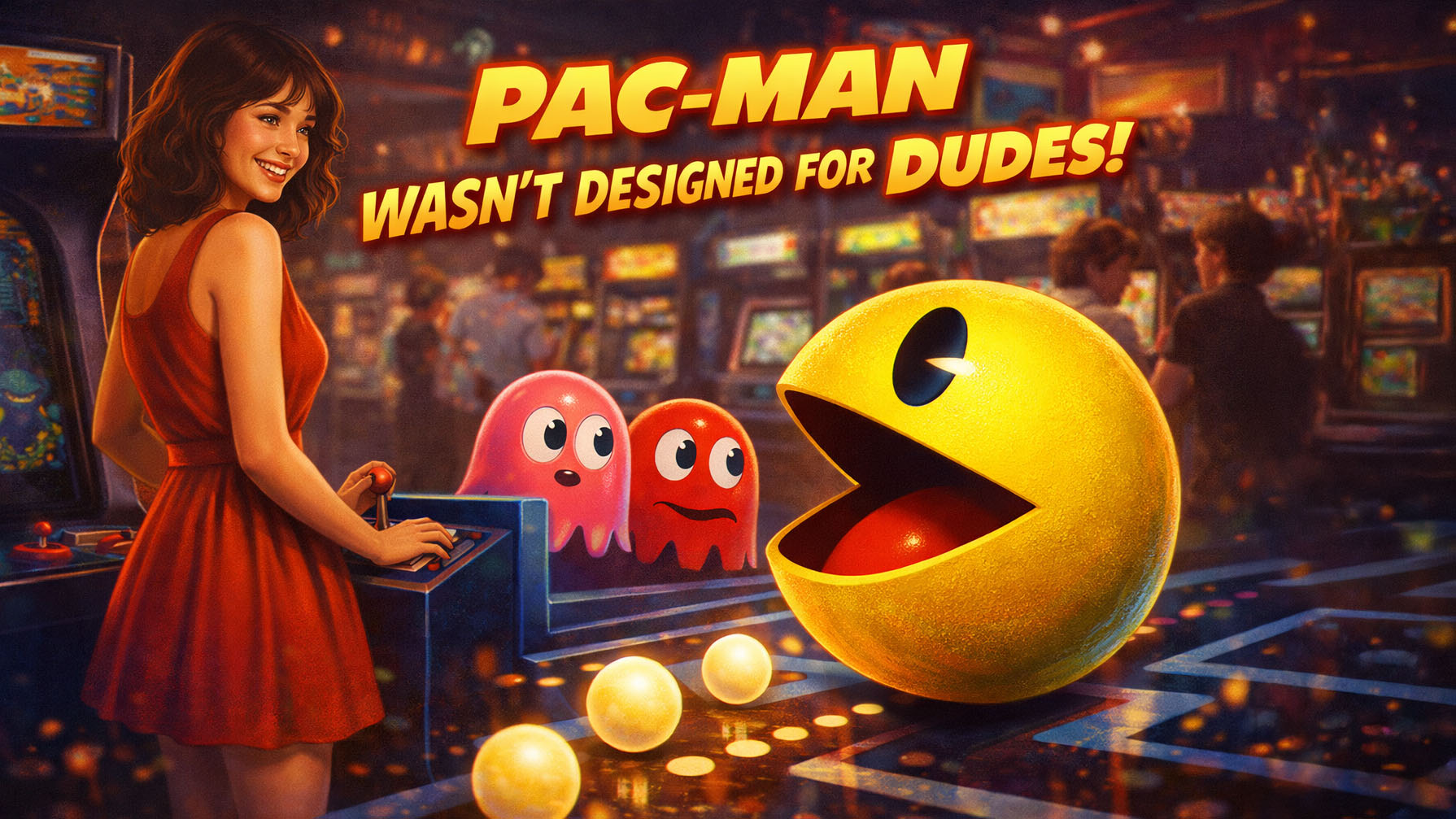
By the late 1970s, arcades had a bit of an identity problem. If you walked into one, you pretty much knew what you were going to get: waves of aliens, spaceships, explosions, and a whole lot of blinking lights. Games like Space Invaders were wildly popular, but they all followed the same formula: fast, aggressive, and heavily geared toward teenage boys.
And for a while, that worked.
But it also meant something important: a huge portion of potential players simply weren’t interested. Arcades weren’t failing yet, but they were becoming narrowly defined spaces. If you didn’t connect with that style of game, there wasn’t much of a reason to be there.
That’s where Toru Iwatani, a young designer at Namco, saw an opportunity.
Instead of asking how to make a better shooter, Iwatani asked a completely different question: what kind of game would appeal to people who weren’t coming to arcades at all? What if they were women?
At the time, that was a pretty radical idea.
A Completely Different Kind of Game
Iwatani’s approach was almost the opposite of what the industry was doing. Instead of focusing on combat, he focused on something universal: eating.
It sounds almost ridiculous now, but it was a deliberate choice. Eating is something everyone understands. It’s approachable, non-threatening, and oddly satisfying as a game mechanic.
According to the famous origin story, the inspiration came from a pizza with a slice missing. Whether that’s 100% accurate or not, the result was clear: a simple, round character navigating a maze, eating dots, and avoiding ghosts.
No weapons.
No violence.
No complicated controls.
Just movement, timing, and pattern recognition.
It was a massive departure from everything else in arcades at the time, and that was exactly the point.
Designed to Feel Welcoming
What made Pac-Man truly different wasn’t just the concept! It was the execution!
Every detail of the game was designed to feel more inviting than intimidating. The maze was clean and readable. The colors were bright. The characters (even the ghosts) had personality instead of menace. The sound effects were playful rather than aggressive.
Even the difficulty curve was carefully tuned. You could understand the game within seconds, but mastering it would take much longer.
This wasn’t an accident. It was one of the earliest examples of a game being intentionally designed for accessibility and broad appeal.
And it worked!
A New Audience Walks Into the Arcade
When Pac-Man launched in 1980, it didn’t just perform well, it changed who showed up.
For the first time, arcades began attracting a much more diverse crowd. Women, younger players, and even people who had never considered themselves “gamers” were suddenly lining up to play.
Couples played together. Kids could jump in without feeling overwhelmed. People who had zero interest in shooting aliens found themselves hooked on chasing high scores in a maze.
Pac-Man didn’t just become a hit, rather it expanded the entire market.
That’s the part people often miss. It wasn’t just a successful game. It brought in new players who weren’t there before.
The Shift From Games to Characters
Before Pac-Man, most arcade games didn’t really have characters in the way we think about them today. You had a ship, or a paddle, or maybe a vague representation of something, but not personality.
Pac-Man changed that almost overnight.
Now you had a recognizable character. You had enemies with names and behaviors. You had something people could connect with beyond just gameplay.
That shift opened the door for everything that followed: Mario, Sonic, and pretty much every mascot-driven franchise that defines gaming today.
The Real Lesson (And Why It Still Matters)
It’s easy to say Pac-Man succeeded because it was designed for women, but that’s only part of the story.
The real reason it worked is because it removed barriers. It proved that games didn’t need to be aggressive, complicated, or exclusive to be successful. They just needed to be intuitive, engaging, and welcoming to a broader audience.
By trying to include more people, Pac-Man ended up appealing to everyone. And in doing so, it helped arcades grow beyond a niche hobby into something much bigger.
Forty Years Later… The Same Idea Still Works
If you look at what makes a great arcade today, the formula hasn’t really changed.
The best games are still the ones you can walk up to, understand instantly, and enjoy whether you’re a hardcore player or someone just looking to have fun for an hour.
That idea that designing games for people, not just players, it started with Pac-Man. And it’s a big part of why arcades didn’t fade away. They evolved.
Pac-Man wasn’t just a clever game about a yellow circle eating dots. It was a turning point!
And it all started with a simple question most of the industry wasn’t asking: What if we made something for everyone instead?